
Domestic aerials and satellite dishes Installation and repair
Dodgy TV reception? Ask us what can be done about it!
Although a large part of our business is concerned with commercial installations of one sort or another we are always delighted to have domestic work. After all, it’s how our business started, and to be honest it’s nice to have face to face contact with the actual customer.
We only use top quality materials, because it makes no sense for the customer to pay us to install something that isn’t going to last. We have extremely competitive prices. We install and repair domestic equipment including TV aerials, VHF-FM aerials, DAB aerials, and satellite dishes. We can install extra TV sockets, re-align or otherwise fettle your TV aerial and satellite dish. We can fix reception problems. Ring or email us to discuss your requirements.
Television Aerials
To work faultlessly your digital television set and recorder need a reasonably strong, interference-free signal from the aerial. Luckily this is usually quite easy to achieve unless you are in a really poor reception area. A decent quality aerial properly installed, with decent quality cable to the receiver, will do the job. A TV aerial should be fit and forget, with a lifetime of twenty or thirty years. Like new double glazing it’s one of those things you don’t have done very often, so you might as well have it done properly. Cheap aerials won’t give good reception and they won’t last very long, but slightly more expensive ones will, as long as they are properly installed. In terms of value for money it’s a no-brainer, because the cowboy installer who sells junk aerials and doesn’t even install them properly will usually charge as much as someone doing a decent job.

A log periodic UHF TV aerial. Logs are small and light. They are inherently wideband, thus well suited for today’s broadcast environment where transmissions change periodically.
CLICK to enlarge image

A good quality 18 element UHF TV aerial: excellent gain (sensitivity) and directivity but only suitable where all transmissions are within the same channel group, because yagi aerials are not too good for wideband use.
CLICK to enlarge image
For more information about different types of television aerial click here

Aerials sold by DIY shops are poor value!
- Aerials tend to be designed to look good rather than to work well, so they are often unnecessarily big and heavy
- ‘One size fits all’ so the aerial might not be correct for your local channels or your local reception conditions. Let a professional installer chose the best aerial for the job.
- Aerials and accessories are expensive; very bad value for money
For pictures of DIY installations click here
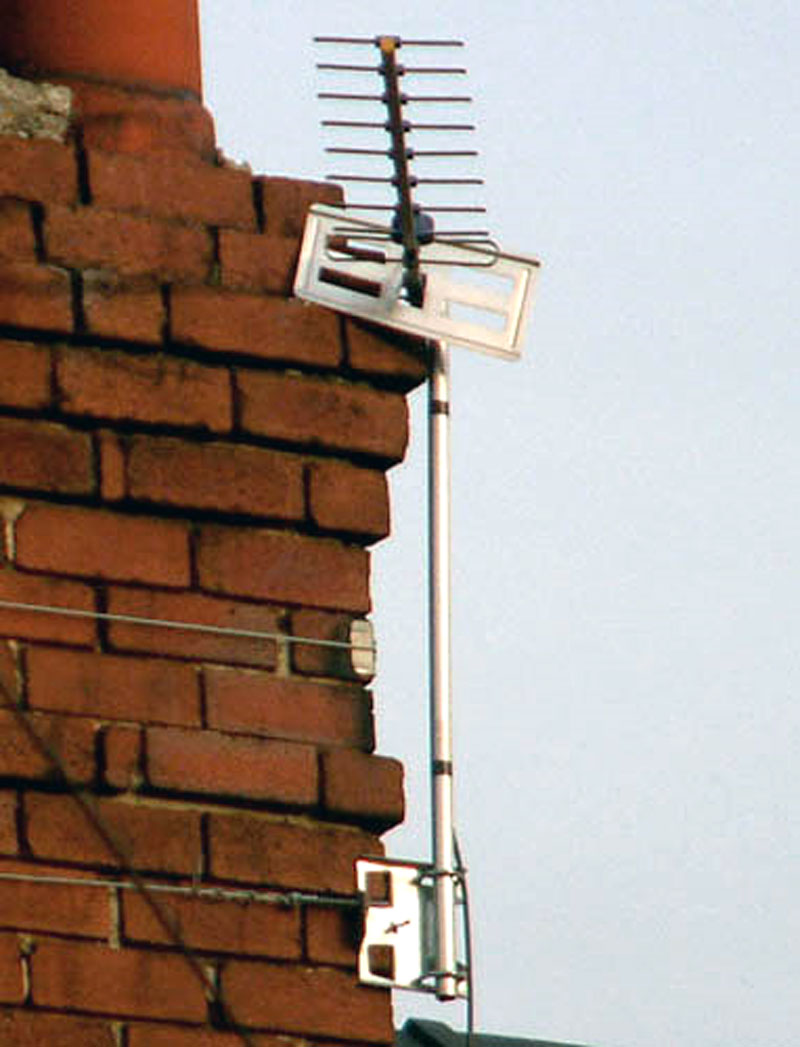
Cheap (‘contract quality’) TV aerials are poor value!
- Flimsy construction using a flat plate reflector
- Connection box often not weatherproof
- Design not properly optimised so reception is sub-optimal
- Fixing clamp not up to the job
- No balun so the aerial doesn’t electronically match the cable
- Inadequate corrosion protection.
CLICK to enlarge image
The strength and quality of the TV signal varies from place to place, so it’s important that the right sort of aerial is used for your location. We always test the signal before installation using a spectrum analyser
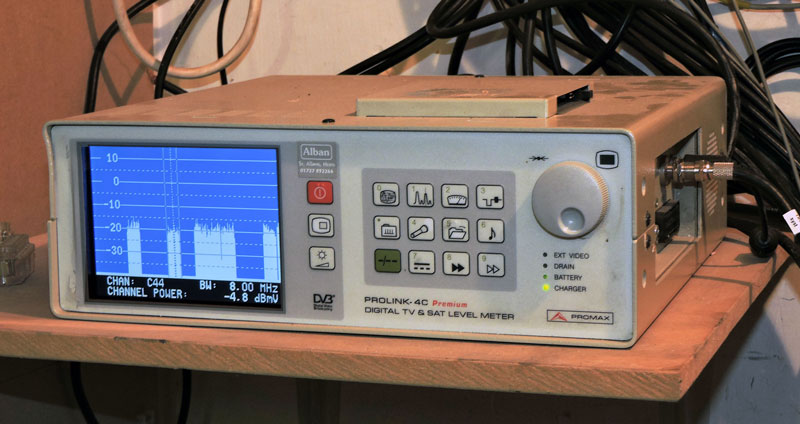
This is one of our bench analysers. The one used on rooftops has the same functions but is more portable] and will advise you about what’s needed. Unlike many installers we do not believe in selling large expensive aerials when they aren’t necessary. That, we are sorry to say, one of the common sins of the rip-off merchants who infest our trade.
CLICK to enlarge image
Because digital signals are quite robust it is possible, in really good reception areas, to get reliable reception from a loft aerial. It’s worth discussing this with us, especially if an outdoor aerial would be unsightly or difficult to install.
Because the broadcasters make periodic changes to the channels used and the transmission standards, in most parts of the country your new aerial should be ‘future proof’ – able to receive all channels in the TV band. Incidentally we are due for radical changes in 2019/20, when part of the TV band will be given over for mobile phone use. Details of these changes are here.
Reception problems

Two aerials accurately phased together can eliminate interference and strengthen weak signals. This is just one technique for improving reception in difficult areas.
CLICK to enlarge image

One of the many types of signal filter than can help solve reception problems
CLICK to enlarge image
When signal strength is very poor large high gain aerials are necessary.
CLICK to enlarge image
We have been dealing with domestic TV reception problems since the very beginning of UHF TV. If you have poor TV or radio reception and other installers have 'thrown in the towel', we might be able to help. Our understanding of TV reception and special aerial installation techniques, and our use of top-end test equipment allows us to provide solutions that are beyond the scope of the vast majority of domestic installers. We can also help if you have problems with satellite reception.
Domestic distribution systems
These are systems that provide TV reception in a number of different rooms. Normally there is an amplifier in the loft or elsewhere that boosts the signals and feeds out to all the TV sets. We install everything from basic aerial distribution systems to Sky Q systems. Your distribution system can include your CCTV pictures, which will be viewable as normal TV channels. But if all you want to do is put TV sets in a couple of extra rooms you might need nothing more than extra cables and a splitter unit. Since Digital Switchover and its accompanying effective transmission power increases we are finding that people often have expensive amplifiers to boost the signal quite unnecessarily.
Specialised satellite installations

A small dish farm for a university language department Ring or emailus to discuss.
CLICK to enlarge image
VHF FM radio aerials
For commercial applications and aerials for transmission please go to our broadcast stations section

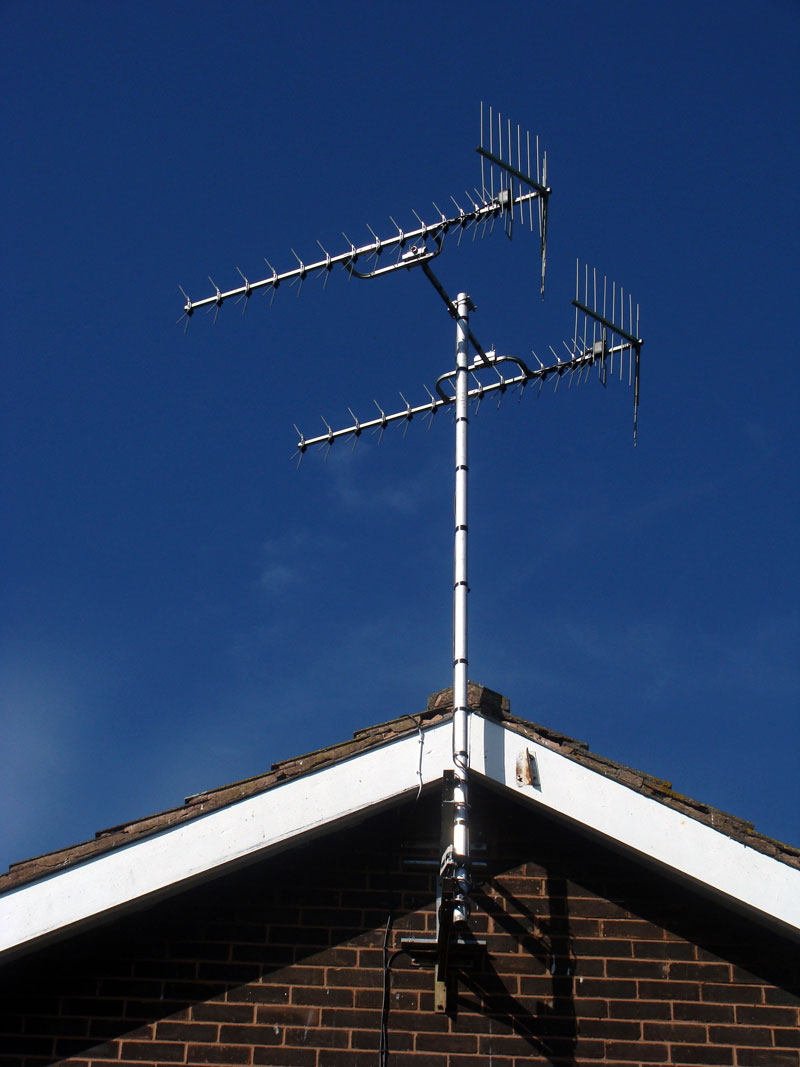
At the top a standard good quality 18 element UHF TV aerial. To the left of the mast is a four element DAB aerial; to the right a vertical dipole for VHF FM. Lower down is a 65cm satellite dish.
CLICK to enlarge image
Most domestic VHF FM and DAB reception these days is via a rod aerial on the radio. However there is still a demand for external aerials in poor reception areas, or where reception of a particular FM station or DAB multiplex is required.
Unless a specific ‘difficult’ radio station is required or there are severe problems caused by signal reflections, we usually use an externally-mounted or loft-mounted vertical dipole for VHF FM. These aerials are not directional, which is a good thing nowadays because transmission stations are all over the place.
You might have seen the little circular FM aerials, known as ‘halos’. They are useless. Intended for horizontally-polarised signals and to be non-directional, they are insensitive and have no logical role to play in the UK where all FM transmissions are mixed polarisation. More about halos
If there’s a weak signal or a multipath (reflected signals) problem we normally use a four or six-element yagi aerial like one of these. Remember, the easiest way to receive the BBC local stations is on Freeview, as long as the one you want is available from your local TV transmitter. Flip through the Freeview radio channels from 700 up. You might find the station you want somewhere in the list.
DAB radio aerials
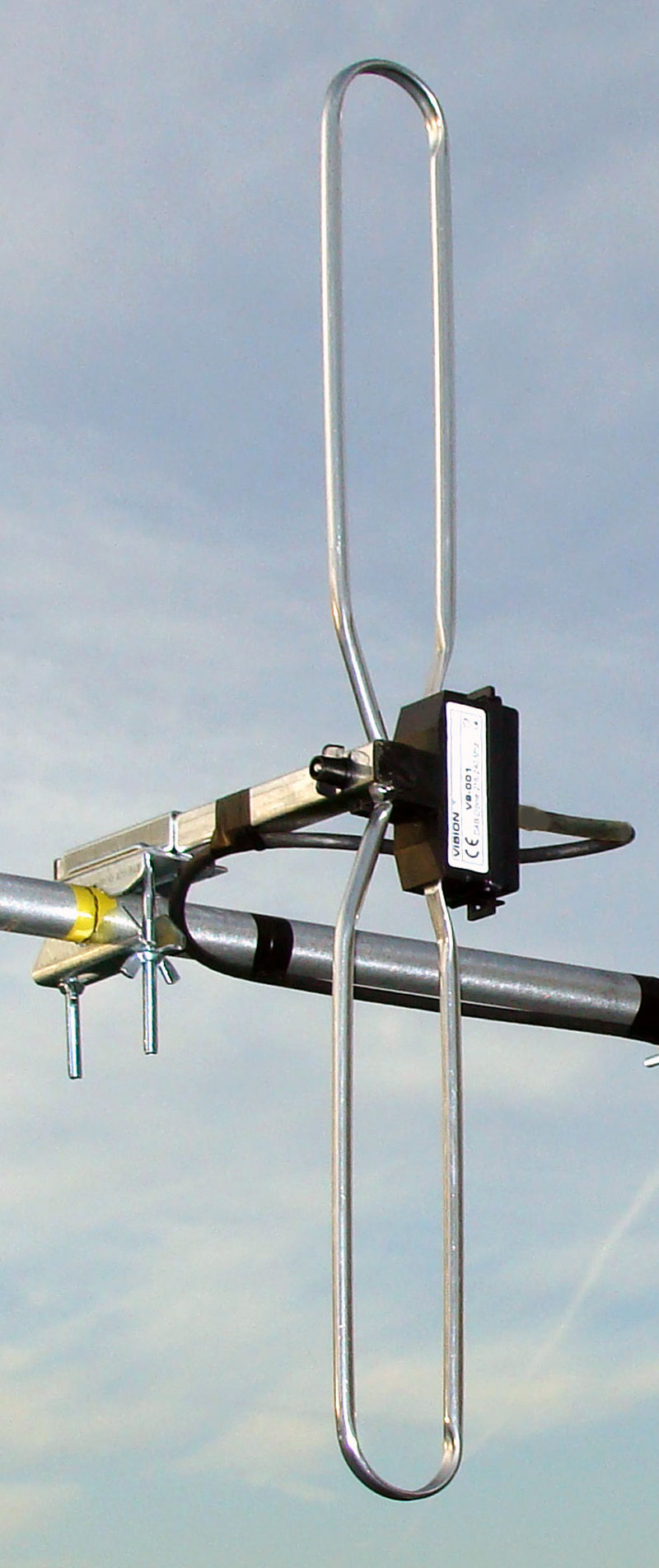
This is a folded (double) DAB dipole. Some are not folded; both types work fine. DAB dipoles are about 700mm long.
CLICK to enlarge image
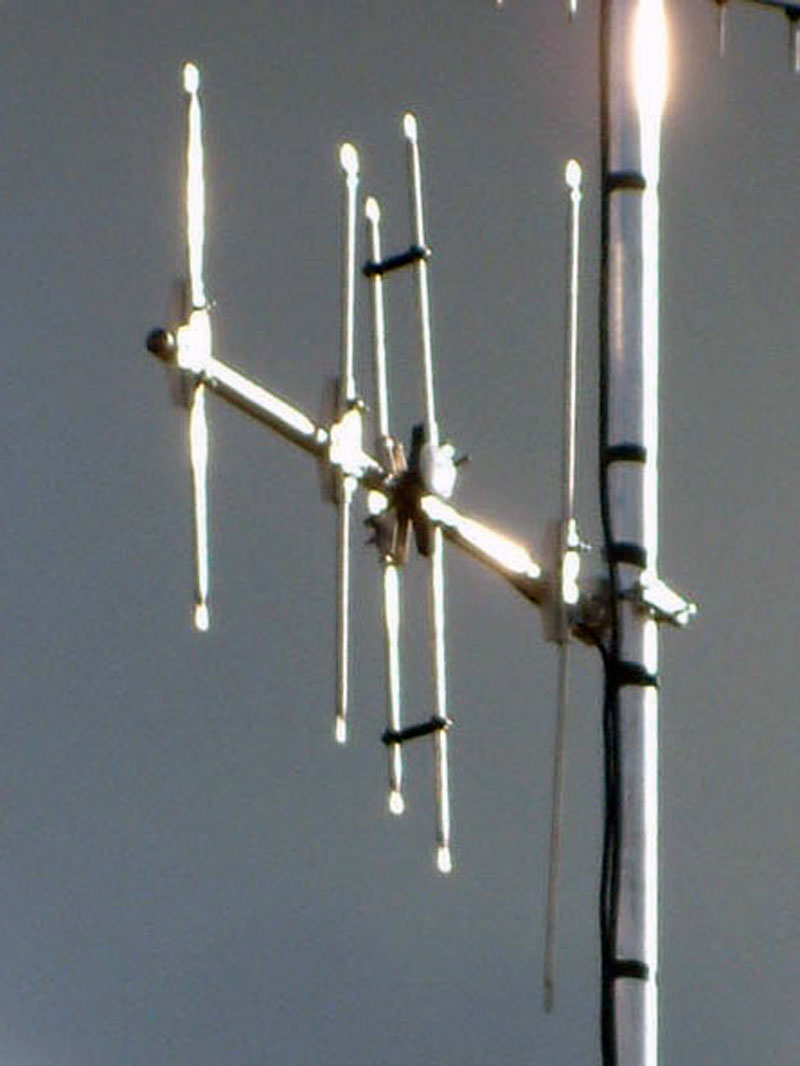
This is a four-element yagi-type DAB aerial, so is directional, but having only four elements isn’t very directional.
CLICK to enlarge image
Much like VHF FM, the most commonly used loft- or outdoor DAB aerial is a dipole. These aerials aren’t directional, which is normally a good thing because DAB transmissions for a particular area are not necessarily co-sited. Again like VHF FM, where there are reception problems it’s possible to use a directional aerial; either a yagi or a log-periodic. Unfortunately, a DAB aerial of practical size can’t, by the laws of physics, be all that directional. This is a particular problem because the reception-limiting factor with DAB is often co-channel interference. Each DAB channel is used repeatedly across the country. A DAB radio faced with two signals on the same channel and of comparable strength won’t decode either.
Multipath isn’t much of a problem with DAB. Because the modulation system was designed for in-car use where signals can be expected to be bouncing off buildings and hills, DAB is almost completely immune to reflected signals.
It’s interesting that most of the large directional DAB aerials we see on the rooftops as we drive about are either (a) assembled incorrectly, (b) not aligned towards a DAB transmitter, or (c) set for horizontal polarization despite there being no horizontally polarised DAB transmissions.